
The Happy Cultural Planner is your guide to the key holidays for the major cultures and faiths. It has now been published by Happy for over 30 years. As well as an indicator of upcoming holidays (including those which may prevent people attending your events), it’s a handy way to plan for the year.
The prices are: 50 x A3 = £125+VAT (including delivery); 100 x A3 = £180+VAT (including delivery). For A2 size, there is a minimum quantity of 100, priced at £700 + VAT (including delivery) – they are printed litho. Please contact us directly to order.


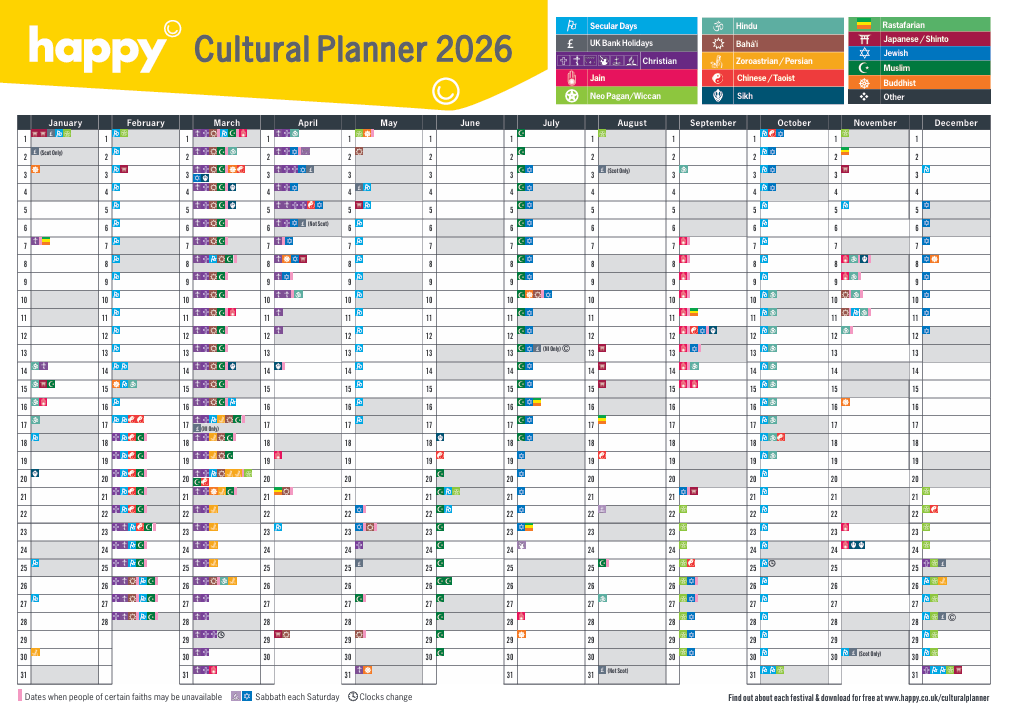
The Happy Cultural Planner is your guide to the key holidays for the major cultures and faiths. It has now been published by Happy for 30 years. As well as an indicator of upcoming holidays (including those which may prevent people attending your events), it’s a handy way to plan for the upcoming year.
The Happy Cultural Planner PDF is a hi-res file and you are welcome to download and print your own copies in A2, A3 or A4 size.


The Happy Cultural Planner is a free document you can download, print and use. See below for a full list of the 2026 festivals, along with their meanings, to help plan for the year ahead.
Disclaimer: Happy Ltd makes no claim of allegiance to, or expertise in, any particular faith or interest group.
The aim of this Planner is to raise awareness of cultural/religious festivals and awareness days which may have significance to communities represented in your workplace. By doing this, we hope to foster interest and understanding of each other’s beliefs and encourage respect for different world views.
Whilst every effort has been made to cover as many significant events as fairly as possible, space is limited and the list is necessarily abbreviated. Significant omissions are therefore unintentional. If you feel an important event has been missed out, misrepresented or is just plain wrong, please contact hello@happy.co.uk and we will correct the online version as soon as possible and the hard copy for next year.

| Date | Name of Festival |
| 1st January | New Year's Day |
| 2nd January | New Year Holiday (Scotland only) |
| 17th March | St. Patrick's Day (Northern Ireland only) |
| 3rd April | Good Friday |
| 6th April | Easter Monday (not Scotland) |
| 4th May | Early May Bank Holiday |
| 25th May | Spring Bank Holiday |
| 13th July | Battle of the Boyne (Northern Ireland only) |
| 3rd August | August Bank Holiday (Scotland only) |
| 31st August | August Bank Holiday (ENG, NIR, WAL) |
| 30th November | St. Andrew's Day (Scotland only) |
| 25th December | Christmas Day |
| 26th December | Boxing Day |
| Date | Name of Festival |
| 7th January |
Ethiopian Christmas |
| 21st April |
Groundation Day |
| 23rd July |
Birthday of Haile Selassie |
| 17th August |
Marcus Garvey's birthday |
| 2nd November |
Crowning of Emperor Selassie |
| Date | Name of Festival |
| 18th February |
Ash Wednesday (Start of Lent; ends 6th April) |
| 2nd April |
Lord's Evening Meal (Jehovah's Witness) |
| 5th April |
Palm Sunday, Holy Week Starts |
| 3rd April |
Good Friday |
| 5th April |
Easter Sunday |
| 31st May |
Pentecost |
| 24th July |
Pioneer Day (Mormon) |
| 22nd August |
Grand Finale of Tabieorar Period (Aladura) |
| 24th December |
Christmas Eve |
| 25th December |
Christmas |
| 31st December |
Watch Night (Pentecostal) |
| Date | Name of Festival |
| 7th January |
Nativity of the Lord (Orthodox Christmas) |
| 14th January |
Replacement Day |
| 23rd February |
Start of Great Lent |
| 5th April |
Palm Sunday/Start of Holy Week |
| 10th April |
Holy Friday (Great Friday) |
| 12th April |
Pascha (Easter Sunday) |
| 31st May |
Pentecost / Trinity Sunday |
| Date | Name of Festival |
| 1st February |
Imbolc |
| 20th March |
Ostara (Spring Equinox) |
| 1st May |
Beltane |
| 21st June |
Litha (Midsummer's Day) |
| 1st August |
Lughnasadh-Lammas |
| 22nd September |
Mabon - September Equinox (9 days) |
| 31st October |
Samhain |
| 21st December |
Yule (12 Days) |
| Date | Name of Festival |
| 14th January |
Makar Sankranti/Pongal (4 days) |
| 15th February |
Maha Shivaratri |
| 2nd March |
Holi |
| 14th April |
Vaisakhi (Hindu New Year) |
| 6th April |
Rama Navami |
| 1st April |
Hanuman Jayanti |
| 27th August |
Rakhi/Raksha Bandhan |
| 3rd September |
Krishna Janmashtami |
| 14th September |
Ganesh Chaturthi |
| 10th October |
Dussehra |
| 8th November |
Diwali (Deepawali) |
| Date | Name of Festival |
| 3rd January |
Mahayana New Year (M) |
| 15th February |
Nehan-e / Nirvana Day |
| 3rd March |
Cho Trul Duchen (Tibet) – full moon This day highlights the end of Losar, 15 days after the Tibetan New Year. On this day it is said that any karma, positive or negative is multiplied by a million times. |
| 8th April |
Hana Matsuri (M) |
| 1st May |
Vesak / Buddha Day (All traditions) |
| 31st May |
Saka Dawa (T) – full moon |
| 21st March |
Higan-e (M) |
| TBC |
Kathina (Th) – full moon |
| 16th November |
Lhabab Duchen (T) – full moon |
| 8th December |
Jodo-e/Rohatsu/Bodhi Day (M) |
| Date | Name of Festival |
| 26th February |
Ayyám-i-Há (Intercalary Days) |
| 2nd March |
Feast of Ala (Start of Nineteen Day Fast) |
| 26th March |
Naw Rúz |
| 21st April |
Ridvan (1st, 9th and 12th are holy days) |
| 23rd May |
Declaration of the Bab |
| 28th May |
Ascension of Baha'u'llah |
| 10th July |
Martyrdom of the Báb |
| 10th November |
Birth of the Báb |
| 11th November |
Birth of Bahá'u'lláh |
| Date | Name of Festival |
| 30th January |
Sadeh |
|
17th March (5 days) |
Frawardigan (Split into two 5 day halves) |
| 20th March |
Nouruz (Iranian New Year) |
| 26th March |
Khordad Sal |
| 26th December |
Zartosht No Diso |
| Date | Name of Festival |
| 17th February |
Start of Spring Golden Week |
| 17th February |
Chinese New Year (Year of the Horse) Lunar New Year is one of the most important traditional holidays in China, and the most widely celebrated by the Chinese diaspora. 2024 is the Year of the Dragon. |
| 3rd Marchy |
Yuan Xiao (Lantern Festival) |
| 20th March |
Zhonghe (Blue Dragon Festival) |
| 5th April |
Qingming (Tomb Sweeping Day) |
| 19th June |
Duanwu (Dragon Boat Festival) |
| 19th August |
Qixi (Double 7th or Chinese Valentine's Day) |
| 12th Septembert |
Zhongyuan (Ghost Festival) |
| 1st October |
Start of Autumn Golden Week |
| 18th October |
Chonyang (Double Ninth) Festival |
| 22nd December |
Dongzhi Festival (Winter Solstice) |
| Date | Name of Festival |
| 1st January |
Gantan sai/OShōgatsu |
| 1st January |
Hatsumode |
| 15th January |
Dōsojin (Fire Festival) |
| 3rd February |
Setsubun Sai (Bean Scattering) |
| 8th April |
Hana-Matsur (Flower Festival) |
| 29th April |
Shōwa no Hi (Emperor Hirohito's Birthday) |
| 5th May |
Kodomo no Hi (Children's Day) |
| 13th August |
Obon (Festival of Souls) (3 days) |
| 21st September |
Keirō no Hi (Respect for the Aged Day) |
| 3rd November |
Bunka no Hi (Culture Day) A day for the promotion of culture of various kinds - from the arts to academics. |
| 31st December |
Ōmisoka (New Year's Eve) |
| Date | Name of Festival |
| 16th January |
Meru Trayodashi |
| 1st March |
Phalguna Chaumasi Chaudas |
| 11th March | Varshitapa Arambha The start of an auspicious period observed by the Jain community. |
| 31st March |
Mahavir Jayanti |
| 19th April |
Varshitapa Parana |
| 28th July | Ashadha Chaumasi Chaudas Chaumasi Chaudas (also known as Varsha Vras) is the most important festival of Jainism. It is a four month period in which Jains focus on their guiding principle of non-violence and charity. The main purpose of this festival is to provide an occasion to reflect on the philosophy and teachings of Lord Mahavir and to practice them for the well-being of oneself as well as the whole world. |
| 7th September | Paryushan (9 day fast - final day festival) Paryushan means 'coming together' and is said to have been initiated by the founder of Jainism. It's a 10 day festival, and for the first 9 days Jains follow a strict regime of fasting and meditating. The final day of Payushan is celebrated with a community banquet. |
| 15th September |
Samvatsari Parva |
| 8th November |
Lakshmi Puja To welcome the goddess Lakshmi, houses are cleaned and decorated and sweets are prepared so that Lakshmi may visit and bestow her blessings on the household. |
| 9th November | Gujarati New Year |
| 4th November | Kartika Chaumasi Chaudas Karthika Purnima marks the end of Chaumasi Chaudas. |
| 24th November |
Kartika Ratha Yatra |
| Date | Name of Festival |
| 20th January |
Birth of Guru Gobind Singh Celebrating the birth of Gobind Singh who became the 10th and final human Sikh Guru. |
| 14th March |
Nanakshahi New Year |
| 4rd March |
Hola Mohalla (3 days) |
| 14th April |
Vaisakhi (Birth of the Khalsa) |
| 18th June |
Martyrdom of Guru Arjan Dev Guru Arjan was the first Sikh Guru who was martyred. His Martyrdom is considered very important to the Sikh religion and is celebrated as such. |
| 12th September |
Sri Guru Granth Sahib Ji |
| 8th November |
Bandi Chhor Divas (Diwali) |
| 24th November |
Guru Nanak Gurpurab Celebrating the birth of Sikh's first Guru and the founder of Sikhism. |
| 24th November |
Martyrdom of Guru Tegh Bahdur On this date in 1675 Guru Tegh Bahdur, the ninth Sikh Guru was martyred in the name of allowing his people to freely practice their religion. |
| 27th November |
Guru Nanak Dev Ji Gurpurab |
| 24th December |
Saka Sihind (three days) |
| Date | Name of Festival |
| 3rd March |
Purim |
| 2nd April |
Passover (Pesach; 8 Days) |
| 22nd May |
Shavuot (2 days) |
| 3rd July |
Tish'a B'Av/The Three Weeks |
| 12th September |
Rosh Hashanah (2 days) |
| 21st September |
Yom Kippur |
| 26th September |
Sukkot (7 days) |
| 3rd October |
Shemini Atzeret (2 days) |
| 5th December |
Chanukah This holiday marks the rededication of the Temple in Jerusalem, after a small group of Jewish fighters liberated it from occupying foreign forces. |
| Date | Name of Festival |
| 15th January |
Isra and M'raj |
| 18th February |
Ramadan begins (30 days) |
| 18th March |
Laylat-al-Qadr |
| 20th March |
Eid-al-Fitr (End of Ramadan) |
| 27th May |
Eid-al-Adha |
| 20th June |
Muharram (29 days) (New Year) |
| 26th June |
Ashura |
| 25th Augustr |
Milad un Nabi (Mawlid) |



Hear from inspiring female leaders on 12th November, held online via Zoom.





Build your Excel skills from beginner to expert. Perfect for mastering data analysis and visualisation.

Outline the 10 core principles for a happy workplace. It has since helped thousands of leaders build trust-driven, empowered teams.
We've received your message and will get back to you soon. In the meantime, you may find this of interest:
The Happy Manifesto features ten core principles for creating happier, more engaging places to work. We offer all of Henry's books as free downloads.


